Three visions, one diagnosis, no consensus. How Europe’s leaders mark their position on growth, sovereignty and the path forward.
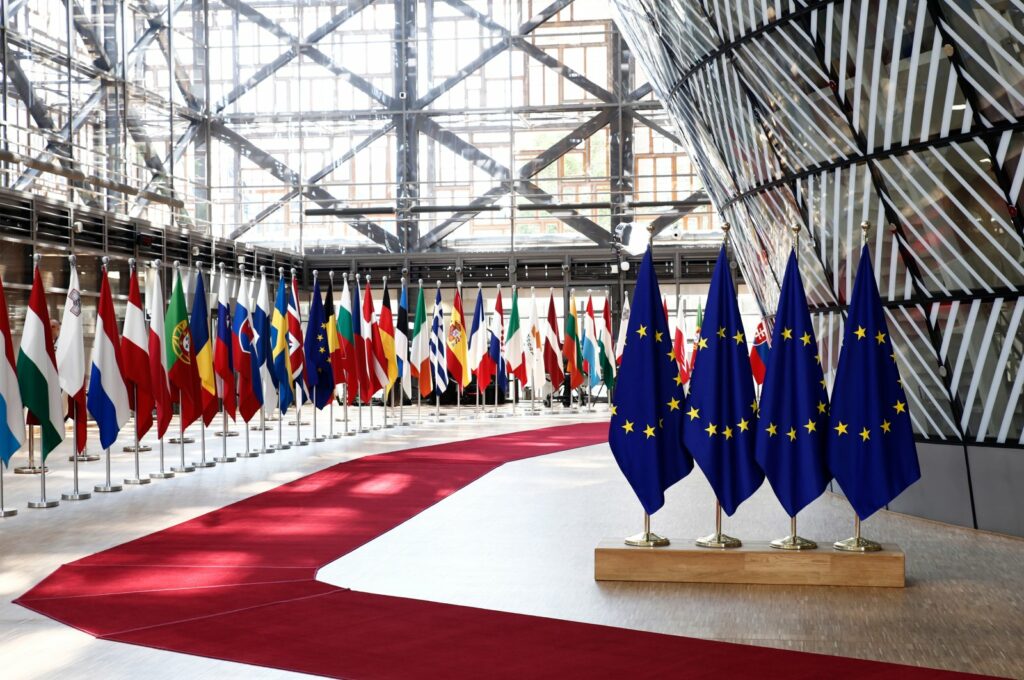
Before the EU leaders’ gather for an “informal retreat” on 12 February in the Alden Biesen castle, Belgium, three competing visions for Europe are taking shape.
All start from the same diagnosis: the status quo is failing. Europe is growing too slowly, investing too little, and depending too heavily on external powers for its security, technology and prosperity. Where they diverge – sharply – is on priorities, instruments, and political method.
The debate is no longer about whether Europe needs to act, but about how it should do so, and at what political and economic cost.
The French grandeur: strategic acceleration in a geopolitical emergency
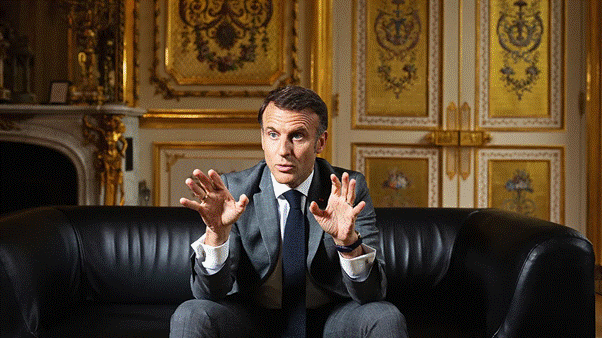
France has chosen to frame the moment in the starkest possible terms.
In an interview published on 9 February across six major European newspapers, Emmanuel Macron warned that Europe is facing a “geopolitical and geo-economic state of emergency”. If it fails to invest and lift barriers to growth quickly, he argued, it risks being swept aside by American technological dominance and Chinese industrial power.
For Paris, this is not a cyclical competitiveness problem but a structural rupture. Macron’s message to fellow leaders is built around four pillars. First, a renewed push for simplification: Europe’s regulatory density, once a source of stability, is now seen as a drag on innovation and scale. Second, a reduction of strategic dependencies, ranging from energy to cloud computing.
This includes reinforcing the international role of the euro – through tools such as euro-denominated swap lines – and reducing reliance on critical non-European suppliers.
Third comes the most controversial element: a policy of “European preference” for critical industries such as steel, chemicals and defence. In practice, this would mean tying state aid and public procurement to minimum European content requirements. Finally, Macron calls for a much stronger EU-level investment effort, public and private, in line with the recommendations of Mario Draghi’s 2024 report. His proposal for “eurobonds for the future”, channelled into defence, green technologies and AI, explicitly seeks to mobilise Europe’s high savings rate for strategic purposes.
Macron describes the current moment as a “Greenland moment”: a shock that briefly forces Europeans to confront the reality of an increasingly hostile international environment.
Whether Paris can turn this vision into a durable coalition remains uncertain – especially given France’s domestic political fragility. Yet few European capitals dispute Macron’s core claim: Europe is too slow, too fragmented, and running out of time.
The productivity-first camp: discipline before ambition
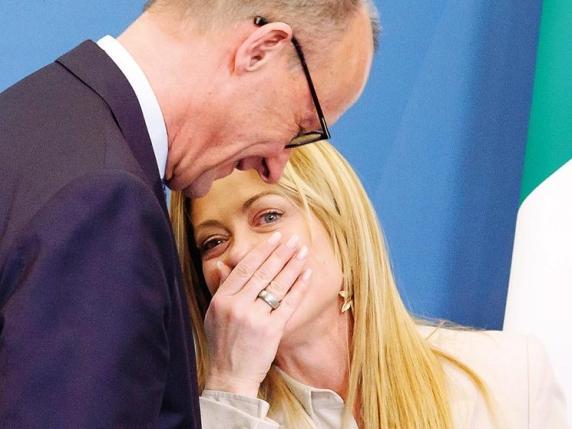
Germany and Italy have articulated a markedly different response. At their recent bilateral summit in Rome, Berlin and Rome pushed back against calls for new debt-fuelled investment drives or explicit industrial protectionism. Their shared emphasis is on productivity, competitiveness and supply-side reform.
From this perspective, Europe’s problem is not primarily a lack of spending, but a failure to translate existing resources into growth. Industrial efficiency, deregulation, labour market flexibility and capital market development are seen as the real levers of competitiveness. Additional borrowing at EU level, German officials have argued in recent statements, risks distracting from these structural challenges rather than solving them.
“European preference” is viewed with particular scepticism. Both Berlin and Rome worry that tying subsidies or procurement too tightly to European inputs could push foreign investment away at a moment when Europe still depends on global capital and technology. Germany, in particular, remains wary of a significantly stronger euro, which could undermine export competitiveness in an already fragile industrial landscape.
This camp does not deny Europe’s strategic vulnerabilities, but it resists framing them as a justification for abandoning open markets.
The Brussels approach: integration through pragmatism
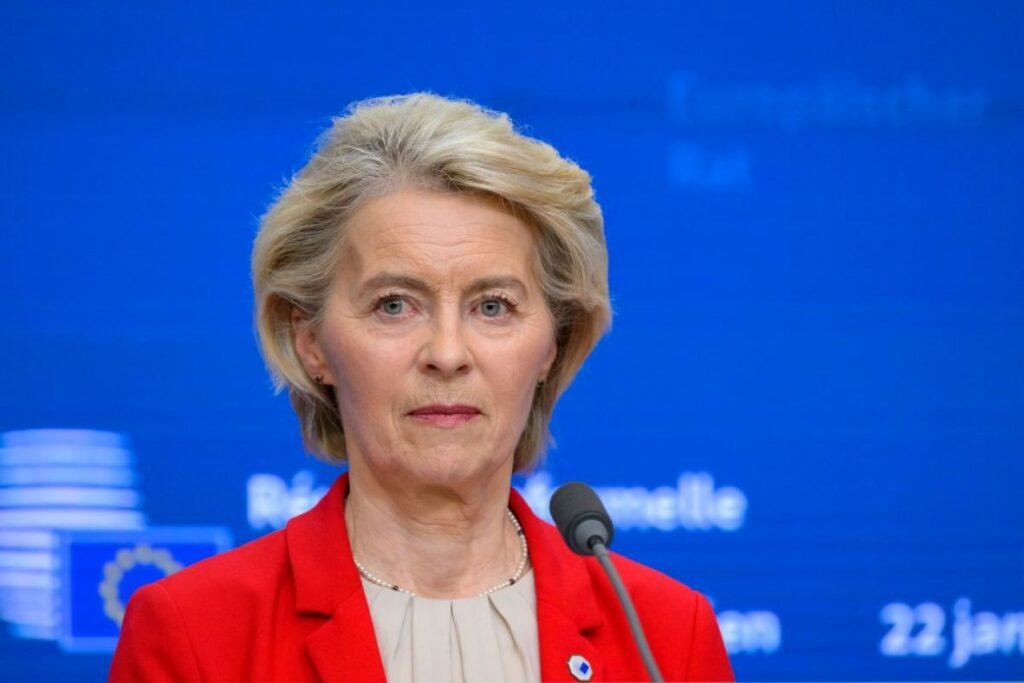
Caught between these poles, the European Commission advances cautiously, wary of overly controversial positions.
In a letter to EU leaders ahead of the summit, Commission President Ursula von der Leyen set out her vision, focused on concrete deliverables, identifying the core drag on Europe’s economy as a fragmented single market – one that functions like a 45% tariff on goods and a 110% tariff on services.
The Commission’s proposed response focuses on cutting “gold-plating”, enforcing existing rules more effectively, and deepening integration where possible. Crucially, von der Leyen signalled openness to using treaty-based enhanced cooperation if unanimity among all 27 proves impossible. Coalitions of willing states, she suggested, may need to move ahead first.
This positioning reflects the Commission’s struggle for relevance and political constraints. On one hand, Industry Commissioner Stéphane Séjourné – closely aligned with the French agenda – has recently signed an op-ed, published across Europe, advocating “Made in Europe” principles, signed by more than 1,000 European industry leaders.
On the other hand, President von der Leyen has made deregulation, simplification and competitiveness the organising principles of her second mandate, a position closely aligned with the Italo-German sensibilities.
The Commission, as always, is attempting a difficult balancing act: maximising the level of ambition that can still command broad political support from Member States. It seeks deeper integration without formal protectionism, and faster progress without forcing unanimity. Whether this synthesis can hold is uncertain.
The gap between advocates of a European preference and those resisting it, between investment-driven sovereignty and competitiveness-first discipline, may prove too wide to bridge.
The risk for the Commission is to becomes trapped between Member States’ divisions, reduced to a spectator rather than a leader in this phase of European integration, as intergovernmental cooperation – driven by bargaining among national capitals – takes precedence over the Community method, in which the Commission initiates legislation and common European rules are shaped through supranational decision-making.
Bonus – the stone guest: Draghi’s pragmatic federalism
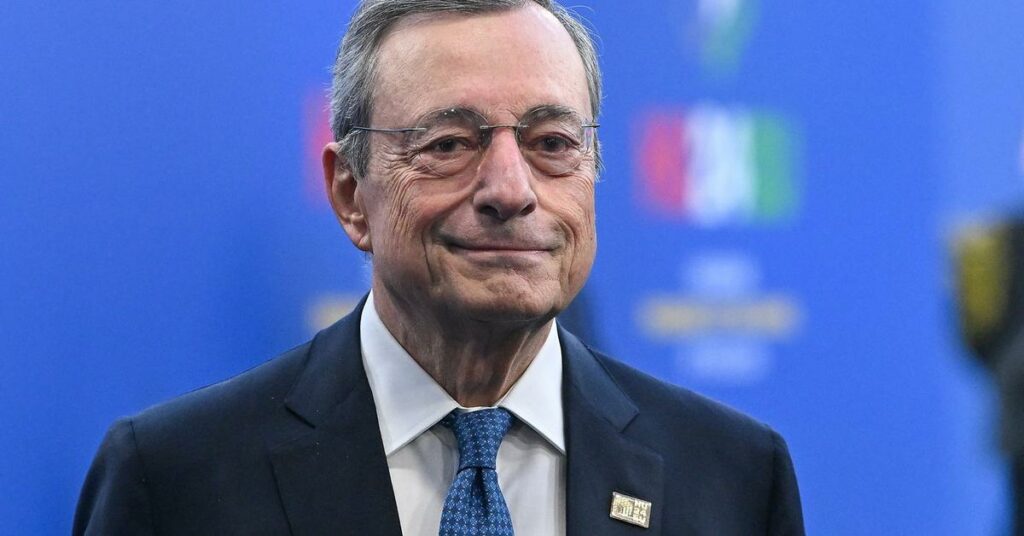
Hovering over all three visions is Mario Draghi’s warning. In a recent speech in Leuven, the former ECB president argued that the old rules-based order is defunct – not because it failed, but because it has been deliberately undermined.
Draghi’s core point is stark: individually, most EU member states are not even middle powers. Europeans, uniquely, have the option to become a genuine power – but only through deeper integration and political coordination. This, he argues, requires a form of “pragmatic federalism”: coalitions of willing states sharing sovereignty where progress is possible, rather than waiting for unanimity.
Importantly, Draghi rejects the idea that unity must precede action. Unity, he argues, is forged through consequential decisions taken together. Europe’s democratic constraints are not a weakness but a defining feature – integration built on common will and shared benefit, rather than force.
In that sense, Draghi reframes the current debate. Investment versus discipline, protection versus openness, 27 versus coalitions – these are tactical disagreements. Strategically, all roads lead back to the same condition: without a genuinely integrated European economy, Europe cannot finance innovation, scale industry, or defend itself.
Leave a Reply