
The EU-India trade agreement – Why it matters, what will change, and why it is a win for Europe
The European Union is on a trade-agreement offensive.
Only weeks after finalising its long-awaited agreement with Mercosur, concluded after nearly 25 years of negotiations, Brussels is preparing to seal another landmark deal.
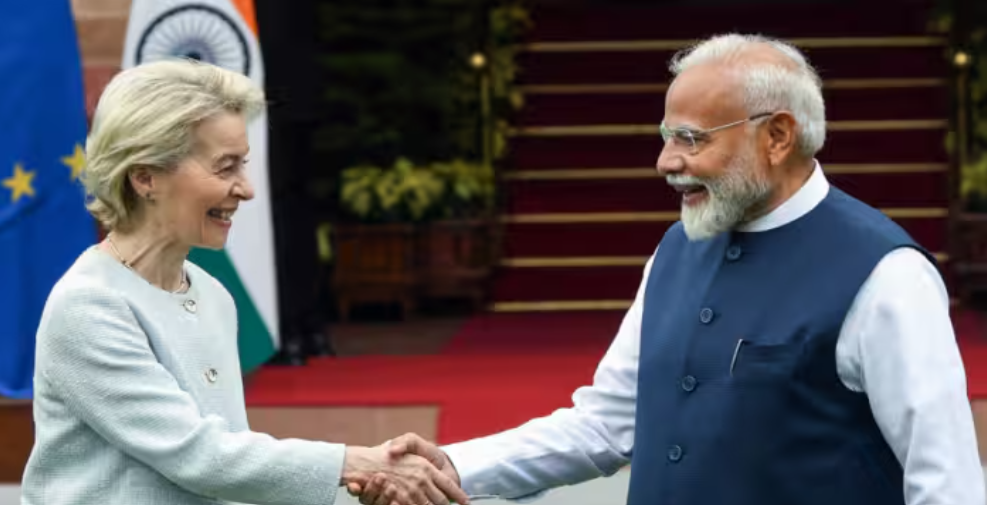
On 27 January, European Commission President Ursula von der Leyen is expected to announce the conclusion of a comprehensive free trade agreement with Indian Prime Minister Narendra Modi, marking a major step forward in EU-India relations.
Negotiations between the EU and India have been under way, in various forms, for almost two decades. Launched in the mid-2000s, the talks stalled for years over disagreements on tariffs, market access and regulatory standards, before being formally relaunched in 2022. They are now in their final stretch, with senior officials from the European Commission signalling that political agreement is within reach ahead of the EU-India summit in New Delhi.
At its core, the agreement is a wide-ranging free trade deal covering goods, services and trade rules. But its significance extends well beyond commerce. The agreement is increasingly framed in Brussels as a strategic instrument, anchoring the EU more firmly in the Indo-Pacific and signalling a long-term political commitment to India as a key partner in an evolving multipolar order. Parallel negotiations address investment protection, geographical indications and regulatory cooperation, while political dialogue increasingly touches on industrial policy coordination, security-related issues and broader strategic alignment.
The renewed momentum behind the deal reflects high-level political engagement. Over the past two years, several European leaders – including Italy’s PM Meloni, France’s Macron and Germany’s Merz, as well as Ursula von der Leyen – have made India a priority destination, underlining a shared push for long-term economic and strategic cooperation. Within the European Commission, the file has been closely steered by Trade Commissioner Maroš Šefčovič, who over the past week held final coordination calls with India’s commerce minister Piyush Goyal.
What’s in the deal – and what isn’t
According to Commission sources, most negotiating chapters are now closed, with a limited number of politically sensitive issues still under discussion: agriculture and dairy products remain largely excluded or heavily protected, a long-standing red lines on both sides. India has been cautious about full tariff elimination on sectors such as automobiles and steel, favouring phased reductions or quota-based access. Non-tariff barriers such as regulatory standards and the EU’s Carbon Border Adjustment Mechanism (CBAM), have also been contentious.
If concluded as expected, the deal will significantly reduce or eliminate tariffs across a broad range of products. On the European side, this includes improved access for automobiles, industrial machinery, chemicals and wine, sectors that currently face high import duties in India. On the Indian side, exporters are set to benefit from reduced or zero tariffs on labour-intensive goods such as textiles and garments, electronics, jewellery, chemicals and selected pharmaceuticals. Beyond goods, the agreement is expected to improve market access in services, notably in information technology, business services and parts of the financial sector; the agreement does not include any form of visa liberalisation.
EU Trade strategy beyond Washington
The deal would bring clear benefits to both sides. For India, it would help make its exports more competitive again, after losing preferential access to the EU market in January 2020, and fit into a broader strategy of strengthening ties with a wider range of partners as relations with some long-standing allies become more strained.
For the EU, the agreement offers more than access to the world’s fastest growing economy: it strengthens Europe’s presence in South Asia and supports a broader effort to reduce strategic dependencies, particularly in a context of heightened uncertainty in relations with the United States. The deal also positions the EU as a credible, predictable partner for countries seeking alternatives to the U.S. increasingly hectic commercial policy.
The broader context is critical for both partners: tensions have flared between India and the United States under President Trump, who took a hard line on Modi’s India. His administration scrapped trade privileges for India and imposed higher tariffs on a range of Indian exports, arguing that India was no longer entitled to special treatment and was too protective of its own market.
Across the Atlantic, trade relations have now also become increasingly politicised following the Greenland affair, which exposed the volatility of U.S. trade and foreign policy under Trump’s administration and raised acute concerns in Europe over U.S. reliability.
Against this backdrop, the EU is relentlessly forging a more autonomous trade strategy, seeking to reduce exposure to sudden policy shifts and economic coercion by the United States, broadening its network of partners. Together with the Mercosur agreement and ongoing negotiations with partners in the Indo-Pacific – notably Australia, Indonesia, Thailand and the Association of Southeast Asian Nations (ASEAN), expected to be all finalised by the end of 2027 – the EU-India deal would give European exporters access to what amounts to the largest integrated market ever assembled through EU trade agreements. At a time when European exports have been weakened by slowing global demand and Trump’s reckless tariff policy, this diversification offers both economic breathing space and strategic leverage.
Once political agreement is formally announced, the focus will shift to legal finalisation and ratification, a process likely to take several months. But if completed, the EU-India free trade agreement would mark not just a commercial milestone, but another, unmistakable statement of Europe’s intent to shape global trade on its own terms.
Leave a Reply